27th March 2026 By Paul Yandall | paul@propertyticker.co.nz | @propertyticker
Finance Minister Nicola Willis has outlined the priority groups for fuel should the government need to escalate its response to manage any shortage.

Willis and Associate Energy Minister Shane Jones today outlined how the government will prioritise the distribution of fuel as supplies tightened because of the conflict in the Middle East.
Under the National Fuel Plan, there are four phases of escalating response: Phase 1 – Minor (the current phase), Phase 2 – Moderate, Phase 3 – Major, and Phase 4 – Severe.
The Fuel Security Ministerial Oversight Group is responsible for deciding whether a shift between phases is appropriate, although phases 3 and 4 are still under consultation.
Under the government’s fuel response framework released today, prioritisation would come into effect at Phase 3 – Major, when supplies tightened to the point where allocation decisions would be required to minimise economic and social disruption.
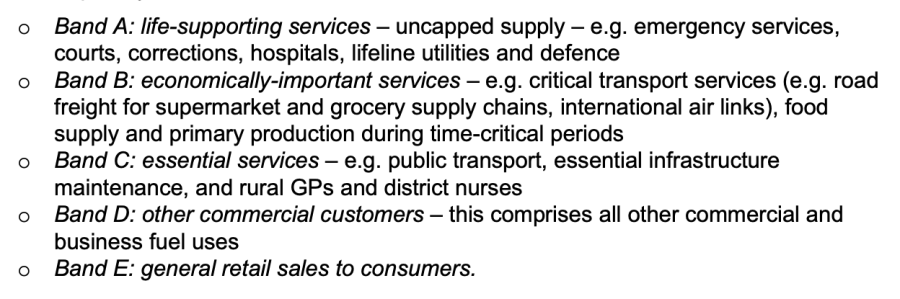
Willis said the government has structured fuel allocation into prioritisation bands.
“Those prioritisation bands are, one, life supporting services. This includes things such as emergency services, courts, prisons, hospitals, lifeline utilities, and essential defense functions,” she said.
“Two, economically important services, such as road freight for supermarket and grocery supply chains, international airlinks, food supply and primary production.
“Three, essential services such as public transport, essential infrastructure, maintenance, rural GPs, district nurses. Four, other commercial users, and finally, general retail sales.”
Willis said the government was consulting with industry, local government, and other community stakeholders about the prioritisation bands and how to best implement response phases 3 and 4.
“We have the gift of time, and we are working with those who would be affected in those phases to ensure we get them right,” she said.
The details of the prioritisation bands came as the Bus & Coach Association sought clarification on where its industry stood.
In an update yesterday, BCA chief executive Delaney Myers said tour services and school transport must be prioritised for fuel supply.
“If we do get to fuel rationing, our position is that public transport, which is prioritised in the National Fuel Plan, must include school transport and tour services,” Myers said.
“We’ve also asked for recognition that workers will need fuel in order to get to work to operate these services. We have been in discussion with multiple agencies and organisations about this.”
Myers added that while indexation was cushioning diesel cost increases for Ministry of Education and public transport contracted operators, that was not an option for tourism transport operators.
“Our thoughts are with operators of tour and charter services who are, in many cases, unable to pass costs through and are currently operating services at a loss. We know you are doing it tough. We also know a lot of staff are struggling to make their way to work.”
The government’s New Zealand’s Fuel Response Plan 2026 can be read here and its National Fuel Plan here, with the Ministry of Business, Innovation and Employment’s information page here and a Q&A here.
Subscribe to The Yield newsletter. Get the latest commercial property news and insights delivered to your inbox every morning.